

By the Dermatics Editorial Team
Medically Reviewed by Dr. Dharmi Kevadiya, MBBS
If sunscreen leaves your face feeling tight, flaky or uncomfortable, the problem may not be sunscreen itself. It may simply be the wrong formula for dry skin.
A good sunscreen for dry skin should protect against UVA and UVB exposure while feeling comfortable on skin that already struggles to hold moisture. That usually means looking beyond the SPF number and paying attention to texture, hydrating ingredients and how the product feels throughout the day.
The best sunscreen for dry skin is usually a broad-spectrum SPF 30 or higher formula with a comfortable, hydrating base. Look for ingredients such as glycerin, hyaluronic acid, ceramides, or niacinamide, and choose a texture that does not leave your skin feeling tight.

Why Does Dry Skin Need the Right Sunscreen?
Dry skin is more than a lack of facial oil. It often means the outer layer of your skin is not holding enough water.
That can leave your face feeling:
- Tight, especially after washing
- Rough or flaky
- Less soft and flexible
- More sensitive to certain products
- Uncomfortable after using very matte skincare
When your skin already feels dry, using a sunscreen with an overly drying finish can make flakes and tightness more noticeable.
That is why the goal is not simply to find the sunscreen with the highest SPF.
You want a formula that gives you adequate UV protection and is comfortable enough to apply every day.
For dry skin, that often means choosing a sunscreen containing moisturizing or skin-conditioning ingredients and using a suitable moisturizer underneath when needed.

What to Look for in a Sunscreen for Dry Skin
Before you check the SPF number, look at the base formula. A sunscreen for dry skin should work like a light moisturizer that happens to filter UV rays, not a mattifying layer that sits on top of already-parched skin.
1. Broad-Spectrum SPF and PA Rating
- SPF mainly indicates protection against UVB rays, which cause sunburn.
- Broad-spectrum sunscreen protects against both UVA and UVB rays.
- PA rating indicates UVA protection; PA+++ or PA++++ offers higher UVA protection.
- For daily use, choose broad-spectrum SPF 30 or higher. SPF 50 offers higher labelled UVB protection, while water resistance is useful for sports, sweating, or longer outdoor exposure.
2. Hydrating and Barrier-Supporting Ingredients
- Humectants (glycerin, hyaluronic acid): pull water into skin.
- Emollients (dimethicone): smooth out flakes.
- Niacinamide: helps balance out tone and supports the barrier.
3. A Texture You'll Actually Reapply
- Pick a texture that feels like a light moisturizer, not a tight mask.
- The best formula only helps if you're comfortable reapplying it all day.
SPF 30 vs SPF 50: Which Is Better for Dry Skin?
This is where many people get confused.
SPF level does not tell you whether a sunscreen will be moisturizing, heavy or drying.
SPF and texture are separate characteristics.
For example, an SPF 50 lotion can feel hydrating, while an SPF 30 matte gel may feel comparatively dry on some skin.
When deciding between SPF 30 and SPF 50, take into account:
- How much time you spend outdoors
- Your overall sun exposure
- UVA protection
- Water resistance when needed
- How consistently you apply sunscreen
- Whether you can comfortably reapply it
For general everyday sun protection, dermatologists commonly recommend broad-spectrum SPF 30 or higher.
So if you are specifically searching for a sunscreen for dry skin SPF 50, do not look at the SPF number alone. Check the sunscreen base, finish and supporting skincare ingredients too.

5 Sunscreens to Consider for Dry Skin in India
Once you know what to look for, shortlisting gets a lot easier. Here's how five Dermatics sunscreens stack up for dry skin, based on texture, SPF/PA rating, and the ingredients that actually support a dry barrier.
|
Product |
SPF / PA |
Texture |
Best For |
|
SPF 50+ PA+++ |
Hydrating water-based lotion |
Daily wear on dry, sensitive, or combination-dry skin |
|
|
SPF 50+ PA+++ |
Soft silicone gel-cream |
Dry, sun-sensitive, or photodamaged skin that wants a smooth matte finish |
|
|
SPF 30+ PA++++ |
Lightweight silicone gel |
Dry skin that prefers a barely-there feel |
|
|
SPF 30 PA+++ |
Water-based gel |
Combination-dry skin, especially in humid weather |
|
|
SPF 50+ PA+++ |
Sweat-resistant matte gel |
Dry skin during workouts or outdoor sports |
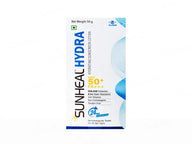
1. Sunheal Hydra Hydrating Sunscreen Lotion SPF 50+ PA+++
Best pick for everyday dryness, on its own or layered over a moisturizer.
- SPF 50+ PA+++ broad-spectrum protection
- Lightweight lotion, no sticky residue
- Ideal for everyday use for mixed, dry, and sensitive skin
- Key ingredients: niacinamide, aquaporin boosters, aloe vera, tetrahydrocurcumin
-16% Recommended
Solasafe Sportz Sunscreen Gel Spf 50+ Pa+++ 50gmRs. 659.00Rs. 789.00
Buy now
Recommended
Solasafe Sportz Sunscreen Gel Spf 50+ Pa+++ 50gmRs. 659.00Rs. 789.00
Buy now
2. Yuvinie Soft Silicone Sunscreen SPF 50+ PA+++
Best for dry, sun-sensitive, or photodamaged skin that flakes or feels tight often.
- SPF 50+ PA+++ with modern UV filters
- Silky silicone base, soft matte finish
- Good if you dislike the "wet" feel of lotions
- Key ingredients: Octinoxate, Bemotrizinol
-18% Recommended
Yuvinie Soft Silicone Sunscreen Gel SPF 50+ PA +++ 50gmRs. 719.00Rs. 879.00
Buy now
Recommended
Yuvinie Soft Silicone Sunscreen Gel SPF 50+ PA +++ 50gmRs. 719.00Rs. 879.00
Buy now
3. Ekran-30 Silicone Sunscreen Gel SPF 30+ PA++++
Best for dry skin that wants a barely-there feel. Layer a moisturizer underneath on flakier days.
- SPF 30+ PA++++, the highest UVA protection grade
- Lighter than a cream or lotion
- Works well layered over a moisturizer
- Key ingredients: Ethylhexyl Methoxycinnamate , Diethylamino Hydroxy Benzoyl Hexyl Benzoate
-21% Recommended
Ekran-30 Silicone Sunscreen Gel SPF 30+ PA++++ 30gmRs. 389.00Rs. 495.00
Buy now
Recommended
Ekran-30 Silicone Sunscreen Gel SPF 30+ PA++++ 30gmRs. 389.00Rs. 495.00
Buy now
4. Yuvinie Sunscreen Aqua Gel SPF 30 PA+++
Best for combination-dry skin, especially in humid weather.
- SPF 30 PA+++ broad-spectrum protection
- Lightweight, non-greasy, quick to absorb
- Suits dry patches on combination skin more than all-over dryness
- Key ingredients: Niacinamide, Hyaluronic Acid
-20% Recommended
Yuvinie Sunscreen Aqua Gel SPF 30 PA+++ 50gmRs. 319.00Rs. 399.00
Buy now
Recommended
Yuvinie Sunscreen Aqua Gel SPF 30 PA+++ 50gmRs. 319.00Rs. 399.00
Buy now
5. Solasafe Sportz Sunscreen Gel SPF 50+ PA+++
Best for dry skin during workouts or outdoor sports. Moisturize first for comfort.
- SPF 50+ PA+++ physical (mineral) protection
- Sweat and water resistant
- Matte finish, no white cast
- Best paired with a hydrating moisturizer for dry or sensitive skin
- Key ingredients: Niacinamide, Aloe Vera, Zinc Oxide

How to Apply Sunscreen on Dry Skin for Best Results
Even the best sunscreen underperforms if you apply it the wrong way. The American Academy of Dermatology (AAD) recommends at least one teaspoon of sunscreen for the face. Dry skin does better with a few extra steps.
- Moisturize first. If your skin feels tight, apply moisturizer before sunscreen, not the other way around.
- Use enough sunscreen. Apply it evenly over your face, neck, ears, and other exposed areas.
- Apply 15 minutes before going out. This gives the formula time to settle evenly.
- Reapply every 2 hours outdoors. Sooner if you sweat a lot or wipe your face.
- Still feels dry? Change the formula, not the amount. Switch to a more hydrating sunscreen instead of using less product.
Common Sunscreen Mistakes That Make Dry Skin Worse
A few habits quietly work against your sunscreen:
- Using too little. Applying too little sunscreen can reduce the protection you get.
- Skipping moisturizer. If your skin still feels tight, layer one underneath.
- Picking by SPF number alone. SPF mainly reflects UVB protection; it does not tell you how hydrating or comfortable the formula will feel.
- Giving up on sunscreen entirely. Switch the texture instead of skipping it.
- Forgetting to reapply. One morning application won't protect you all day.
Conclusion
Don't choose sunscreen by SPF number alone. Look for a broad-spectrum SPF 30 or higher formula that feels comfortable on dry skin. Lotions and creams are common choices, but hydrating gels or fluids can also work well. Ingredients such as glycerin, hyaluronic acid, ceramides, or niacinamide can provide added hydration or barrier support.
Are you still unsure about which one is best for your skin? Book an online consultation with our dermatologists at Dermatics for personalized advice.
This article should not be used as a replacement for expert medical advice; it is merely intended for general informational purposes. If you have persistent dryness, sensitivity, or a diagnosed skin condition, please consult a dermatologist before starting a new sunscreen or skincare routine.


